Tuesday, June 23, 2015

Packrafting the Arrigetch -Part 1

I think it started out as a trip that had something to do with being in our 50th year.  I don't necessarily consider myself to be a big mid-life crisis guy who needs to....prove myself (???) or do something that makes me feel relevant, but then again, if a good buddy wants to go big and another buddy comes up with a great idea to do so, and it happens to correspond with turning 50...well, that's fine; I'm in!  And when I got a packraft last year and told Greg and Mike about it and the possibilities that the ability to carry a 8-10 pound kayak that fits into a backpack but still runs decent whitewater represents, about 4.5 minutes of using The Google and we discovered Packrafting the Arrigetch; a trip that legendary Alaskan adventurer Roman Dial did a few years ago.  Big mountains, fun creeking, several multi-day trips out of a base camp....sounded great.  And since we were baby Alaskan adventurers, we had no problem with doing a trip that had plenty of beta.  And we figured that  -like all baby adventurers  -even with plenty of beta we'd still get plenty of excitement, and indeed we did.
Roman's map of his backcountry AK adventures.  Believe you me, ours does not have very many red squiggly lines!
Our destination was the Gates of the Arctic National Park, which encompasses a good bit of the south side of the Brooks Range, the major range that goes east-west across the top of Alaska.  The park is big:  it's 8.5 million acres/13,000 square miles, which - according to the Wikipedia - is slightly larger than Belgium.  Within the Brooks range are the Endicott mountains, and within those  -tucked into a tiny pocket - are the Arrigetch peaks. "Arrigetch" is apparently native for "5 fingers of an outstretched hand, but I think that really it's like that Indian goddess with many arms; there are lots of "fingers" in those peaks!  The Arrigetch is mostly known as an adventurous climbing area; it was first explored in the 60's and now it sees a few parties a year that haul gear and weeks'-worth of food up into the basins to tackle innumerable 1000-2500 foot walls.  But it's got passes between the peaks and the creeks that the mountains feed into have plenty of gradient and plenty of water, so it makes for great packrafting as well.

Our adventure began in Fairbanks, where they have a good visitors center that is pretty informative for a bunch of fresh-faced lower-48 joeys looking for excitement:

and we hopped into our rental rig to head up the infamous Dalton Highway.  It is "infamous" because we were told that a cracked windshield is pretty much a given, as our flat tires, those donut spare tires are virtually worthless, and grizzlies stop travelers and demand a toll, etc.  We figured that the rep was a bit overblown, but it did come into play when we realized that it is difficult to rent a vehicle to drive up it.  But with a bit of sleuthing and plenty of money we found the standard Dalton Highway Rig (aside from the semis):  the big white pickup.

Of course, it wasn't nearly as bad as we anticipated, until.....it was:

but in the great spirit of "backcountry" travelers helping each other out, one of the first truckers to come by stopped to help us out.

we were all set to change the tire, but he gave us a plug that we stuffed into the hole, and then he had an air compressor on his truck (I marveled at that, and he said "well, ya got compressed air on your rig, so it makes sense to have the hose!" To which I said "Oh yeah, that's right!" But Greg totally busted me by saying "you have no idea what he's talking about!"  which was absolutely true).

And back we were blasting along on our plugged tire.

We crossed the mighty Yukon:

and of course we had to stop and ogle a little at this:

I realized that I didn't really even know what the Arctic Circle was.  I was sort of expecting a big white line going across the road, up and over the pipeline, over the black spruce trees, and of into the distance, with spruce trees and beavers on one side and icebergs and polar bears on the other.  But what we learned from our scintillating stop was that this is the latitude where the sun officially never sets at the summer solstice and never rises at the winter solstice.  And over the course of the trip we very much got that sense - that I'm sure is not even noticed by AK-ers   -that the sun literally was circling us daily; no rise in the east and set in the west up there.

Our destination was Coldfoot, which looks like The Big Town on the map between Fairbanks and Prudhoe bay, but the truth is that it's a truck stop, an airstrip, and another Park Service visitor's center!  (where they kindly loaned us a bunch of bear barrels; they figured the cost of taking out garbage bags of partially-digested people parts is more expensive than free loans of bear barrels!)

We met up with the inimitable Dirk, who owns Coyote Air with his wife, whom we gathered are legends in the Alaskan bush pilot/adventuring communities.

And as we flew, we got a sense of how isolated we were going to be:  we flew for over an hour at a pretty good clip, going from the middle of nowhere to the fringes of that middle.

He plopped us perfectly down on a bouncy gravel bar, we took 3 minutes to unload our gear, and he fired up and blasted off:

And I must say, I had a bit of an unusual sense of excitement and nervousness to watch him fly off, to return in 2 weeks.  It drove home the point that we weren't in the comfy little convenient Wasatch any more!

The first order of business was to set up base camp.  We had a cool little electrified bear fence, but figured with our skull talisman and spraying sharpshooter we'd be safe:
If you were a 1200 pound grizz would you mess with this guy?  answer:  absolutely!  
We did a little day outing on a nearby easy creek, then decided to head up into the goods.  We didn't actually know it, but there is a trail up Arrigetch creek, but - as we said many times, "Alaska doesn't give it up easy!" and the trail was not much more than a game trail. Not only did our little BD trekking poles come in handy, I snapped one as I tumbled over trying to navigate the "trail".
It looks like Phil is trying to avoid the water, but at this point our feet had been soaked for hours
Nice view of Arrigetch Creek.  
the only flat spot for miles, with some glimpses through the clouds of the Arrigetch peaks.  


A shoe dry fest......
that got a little carried away at times. 
 Our original goal was to go way up into the peaks and summit one that was a 3rd class climb, descend the backside, and drop deeply into a creek that would take us out to the main river and back to our camp.  However, the rain that had gotten pretty consistent started getting pretty thick:

and we realized that was going to be unrealistic.  Dirk the pilot had told us that the key to successful adventures in Alaska was flexibility, and this was the first of many times that we would bend to the opportunities and limitations that were presented to us.  It was a little discouraging that time, because we had done a pretty dang steep and long hike:
But so it goes.
Reconciling flexibility
The plan B was a good one, however; just paddle back down the Arrigetch Creek! so after another night in the rain at a nice camp

 we blew up the boats and got ready to blast down the river.  We were not sure where our prior fellow adventurers had put in, so we just went to where it seemed like there was enough water:

and it worked out well:
 Until it didn't:

 It was a bit bony, so we did a combination of running and portaging for a bit, then portaged for quite a ways until we were able to get back on the water.  And even then, it wasn't all runnable whitewater:

The creek averages 250 feet/mile for 5 miles, and that's a very respectable gradient.  We ran a lot of it, but it was a long day, and with the rain the creek was starting to pump up a lot; water was literally pouring down the hillsides into the creek, and the bone of up higher in the drainage was a distant memory as we started to blast holes and desperately claw for eddies.  We weren't able to get many pics due to the wetness, but it was fairly solid and continuous class 4, with lots of blind corners and "real" drops.  At one point Greg asked me "Have you run shit this hard in your packraft before?" which seemed pretty funny to us both, because I hadn't run anything that hard in any craft for a long time!

We kept pressing on down the creek trying to "turn it down a notch" due to fatigue and fear, but the river kept up a pretty ferocious tempo.  Finally at one point I got out to scout and saw a pretty solid long, white, fast, relatively eddy-less section of class 4 - 4+ that blasted around yet another blind corner, and the only line I saw...... was the potential alder thicket thrash to escape the gorge we had been in for hours.   I suggested we pull the plug and there was no argument: we'd been on the river for 12 hours, and due to our leisurely start it was....midnight.  So we deflated the boats and marched back to camp, arriving just in time for our 3am dinner.  So it goes where the sun never sets.

to be continued....


Sunday, May 31, 2015

Prefontaine

Yesterday was the 40th anniversary of the tragic end to Steve Prefontaine's life.  If you don't know about him that's understandable: 40 years is a long time!   Pre was the inarguably the best American distance runner of his era, but in 1975  - the night of a meet where he had brought the Fearsome Finns to Eugene to line up with the best runners in the US  -he crashed his MG on the way home from the celebratory party and was crushed underneath the car, bringing an abrupt end to a career that was assuredly destined for even more greatness.  
The Classic Pre Shot
I was reminded of the anniversary by getting a great link sent to me by Big Alan Meier of an essay done by Jeff Johnson, Nike's first employee and quirky long time track fan.  I won't even try to describe Pre the way that Jeff Johnson does; he knew Pre well and is very articulate, and the essay is so heartfelt - even after all this time - that it's clear that Pre still retains a special place in his heart.  But I will try to describe what Pre meant to me and my cohorts.

I'd love to say that when I was 10 I was a huge fan and followed track and field and distance running and his life- and death- inspired me to take up running, but the truth is that I was 10 and Pre's passing passed me by.  However, I did run my first race a year later, and soon enough I was running cross country and track and someone gave me this great book by Tom Jordan and I think it's safe to say that it changed my life.

There were so many attributes that Pre had that resonated with me:  while it was clear that he was an amazing natural talent, his workout ethics were legendary (he didn't miss a single workout in college, and he was always the guy who wanted to do more, and more.  His pithy quotes were gospel for an aspiring runner:  the "guts" one in the photo, above,  "if someone wants to beat me they've got to bleed to do it", "Over the years, I've given myself a thousand reasons to keep running, but it always comes back to where it started. It comes down to self-satisfaction and a sense of achievement."  No one will ever win a 5,000-meter race by running an easy two miles. Not against me." and "some people might think that pace is suicidal; well; it's a good day to die!"

I apparently had mostly slow twitch muscles even when I was an adolescent, and if anyone was near me at the end I would lose the sprint, but Pre  - with his famous front-running style - was a big advocate of just pushing people so hard in the middle of the race that they would either not be around for the finish or had nothing left for the finish, something that I tried to take to heart myself (though anyone who can run a 3:55 mile has plenty of leg speed; he just perceived that he wasn't as fast and didn't want to leave the finish up to chance).   15 years after his death, I was still doing "Pre" workouts:  one memorable one was a 3/4 mile that started with a 60 second lap, then into a 65 second lap, then a 70 second lap, then don't even stop and head out the door for a hard 6-7 miles with a harder surge in the middle, and looping back to the track to finish with another 3/4 mile going 70, 65, and then 60 secs.  I never even came close.....

One of the most important aspects of Prefontaine is that he was cool, and he made distance running cool.  For sure, when he started at University of Oregon he was a scrawny little dork, but after an amazing debut season there he ended up on the cover of Sports Illustrated:

Yes, there had been milers Jim Ryan and Marty Liquori, and longer-distance (and marathon gold medalist) Frank Shorter:
Pre and Shorter the day before Pre's accident
But Pre - with his trademark "outlaw" mustache, brash behavior (yet seemingly endless capacity to give himself to people, whether they be friends or school kids he regularly gave presentations to), and outspokenness (fighting the AAU to get them to get rid of the "amateur" status of Olympic-caliber athletes so that they could compete with the likes of the state-sponsored Finns and Russians) seemed to take the gawky nature of runners and make it cool; something that is all important when you are an impressionable high schooler (to be sure, our 1982 cross country team was chock full of dorks and misfits who reveled in the lack of hand-eye coordination needed to run with no need to move out of a linear plane!).

And just as important as his influence on the likes of me was the influence that he had in creating Nike (and the subsequent "running boom"); the likes of Phil Knight (still CEO) and Bill Bowerman took the same attitudes of hard work and an unconventional aggressiveness that Pre exemplified into the footwear world and of course has been able to parlay that into being a $20+ billion dollar business (Pre's legacy is well advertised on the Nike Campus:
this is the greeting hall building; other athletes have buildings named after them and are office buildings; this one is basically just a shrine to Pre:
I got this pic off the interweb; I don't know who the dork is with the coonskin cap!
Pre was basically the first shoe company-"sponsored athlete" (aside from Chuck Taylor, of course!), basically paving the way for the likes of Michael Jordan and Lebron James.

And so, 40 years hence, as we lace up our shoes and head out for a run, it's a good opportunity to think about the influence of the brash young "rube" (as Bowerman called him; a good-natured jibe at his humble upbringing) who fundamentally changed running.  Below is part of Bowerman's eulogy:

“All of my life – man and boy – I’ve operated under the assumption that the main idea in running was to win the damn race. Actually, when I became a coach I tried to teach people how to do that. I tried to teach Pre how to do that. I tried like Hell to teach Pre to do that… and Pre taught me – taught me I was wrong.
Pre, you see, was troubled by knowing that a mediocre effort could win a race, and a magnificent effort can lose one. Winning a race wouldn’t necessarily demand that he give it everything he had from start to finish. He never ran any other way. I tried to get him to. God knows I tried.
But Pre was stubborn. He insisted on holding himself to a higher standard than victory.
A race is a work of art. That’s what he said. That’s what he believed. And he was out to make it one every step of the way.
Of course, he wanted to win. Those who saw him compete and those who competed against him were never in any doubt about how much he wanted to win. But how he won mattered to him more.
Pre thought I was a hard case. But he finally got it through my head that the real purpose of running isn’t to win a race. It’s to test the limits of the human heart. And that he did. Nobody did it more often. Nobody did it better.


Thursday, May 21, 2015

Floating Hypocrisy?

Last week there was a big protest in Seattle of some 500-odd kayakers surrounding an oil rig of Shell's that is destined for the Arctic; this was the result of President Obama giving the go ahead to Shell to start doing deep water drilling off the coast.

Disappointing at best, considering that a) the US is already the number one oil producer these days, b) oil is already at quite-low prices, meaning that large investments in both real capital, political capital, and environmental risk have a higher likelihood of not paying off, and c) despite the rhetoric that Obama has employed about the effects of environmental degradation and increased global warming associated with non-renewable resources he went ahead and allowed this to happen, without EVER calling for any kind of concept of energy conservation nor being a true visionary, man-on-the-moon style leader on increasing renewables in this country.  I could go on and on about this, but Eugene Robinson nailed it well here and that's not the point of this post.

So what is the point? Earlier this week I saw a facebook post by someone who referred to a picture of the protesters and said "and look!  Their kayaks are MADE OF PETROLEUM!"  To which someone else replied "yeah, and they probably all drove there in their gas-guzzling SUV's too!"  to which some fairly progressive-minded thinkers thought "yeah, that's pretty hypocritical; paddling a plastic boat to decry the extraction of the raw material necessary to make their plastic boats!"  And of course, pictures of a determined, righteous protester like this:
who is clearly oblivious to the irony of having sHell NO" on her plastic paddle blade contributes to the perception of hypocrisy.  

But does hypocrisy preclude activism?  There is no doubt that yes, boats are made of plastic, and yes those protesting recreators (or is that recreating protesters?) did drive there in their cars, sucking down gas because electric cars don't have the range for them to drive all over hell and yonder for their pristine rivers and lakes and Smart Cars don't have roof rack space.  So yes, they are part of the problem, but....we are ALL part of the problem!  Any human being in a developed nation is a resource-suck and a big one:  the average North American consumes ten times that of a African.  Yes, a kayak is conspicuous consumption:

But living is conspicuous consumption!   

So the question is this:  does being part of the problem preclude being part of the solution?  I don't think so.  It strikes me as awfully smug form someone to sit in front of a screen and sneer at environmental activists who "should" be paddling canoes made from Douglas firs that they towed from the forests to the sea behind their bikes (eating moss for sustenance on the way) for their passion to try to stop the endangerment of pristine Arctic waters and then....do nothing themselves, except continue to add to the problem.  

It begs the question:  is hypocrisy worse than apathy?  I think not; at least the former manifests itself in action; the latter is just....lame.  

There is always the opportunity for a bit of self-reflection, habit-reforming, and lifestyle-changing, and hopefully some of those folks in Seattle looked down from the oil rig to the bow of their boats and maybe gave a bit of thought to their own culpability in what was going down.  

Ironically, the day after I saw that exchange, a pipeline blew a hole in Santa Barbara, a beautiful place I used to live and home to tons of sea life.   And 26 years after the devastating Exxon Valdez
spill and a few years after the Deepwater Horizon accident there is not any more assurance that oil extraction/transportation is any safer than it used to be.  

So if you find yourself in an opportunity to be an activist to try to affect some positive change (and if you are into anything, there is opportunity for activism in it!), don't let the concept of "hypocrisy" that will invariably be brought up deter you from being part of the solution.

Saturday, May 16, 2015

An Ode to a classic: Chuck Taylors

 I have been doing footwear my entire career, starting at Nike prior to the introduction of the Air Max and about the time the first Air Jordan was introduced.  I've had the pleasure of being part of the development of multiple iterations of Nike's air technology, worked on shoes for soccer, basketball, football, baseball, road and trail running, hiking, backpacking, cycling, "Cross Training", minimal, low drop/zero drop, orthopedic, ski boots, high heels, work boots, hunting boots, fishing boots, climbing/approach shoes, military boots, sandals,...on and on.  I have a pair of Vibram Five Fingers that I was given by Vibram's CEO at the time because he told me one of his Italian compatriots had designed a shoe that the CEO thought would be good for kayaking and I was the only kayaker he knew; little did he know that he was literally sitting on what would become a running phenomenon.

I fortunately haven't needed to pay for many of them, and as a result my pile of shoes  - that was a bit legendary when I was in Portland working for Nike and it was in full view; it's still big but now I have it somewhat less visible  - is enormous, despite half-hearted attempts at periodic purging.

Here are a few of my faves:

the original Air Huarache.  They reintroduced it recently as a classic
the "Air Current", a step beyond the original Sock Racer.  Way ahead of its time.  
this pattern was called the Air Wildwood; one of the original trail running shoes that Nike introduced but never really supported.  This particular shoe, however, is unique; I made it with my bare hands!  (don't look at the stitching very closely)
The Air Potato. 
An original Nike Snow Boot, circa 1984.  Never been worn outside!  
A shoe that is fully deconstructable. Yes, that's a swoosh on the side.  
size 13 "running" shoes that I used for summertime testing with size 27 ski boot liners in them.
a deerskin slipper with an old-coin button, leather "lace", and conveyor belt material sole.
a slipper I've had since I was 14
a concept we did for a hut bootie
A "real" Tarahumara sandal from Copper Canyon, and the wooden ball that they use in their epic running games
another potential hut bootie, which is really the bottom of a ski boot liner
A crudely handmade proto of a kayak shoe, that eventually became....
the Patagonia CFS, which eventually evolved to become.....
The Play Boot
Indulging Yvon Chouinard's passion for fishing, we did the "Marlwalker" after spending a week fishing for bonefish in the salt water flats of the Yucatan.  
Further indulging YC, we did an organic cotton sneaker
Some Mongolian yak fur slippers that Mike Libecki brought back from a trip, donated to the Utah Avalanche Center auction, and Ash bought for me.
However, despite this myriad of shoes that can and should work for every foreseeable activity, the truth is that I wear one pair most of the time.  And this is it:
the Converse Chuck Taylor All Star.  

Weighing in at a svelte 1 pound  - twice the weight of new-gen running shoes  - cotton upper, no high tech wicking lining, and with a design that has not changed in eighty-three years!   And despite literally hundreds of shoe companies throwing millions of dollars at the design, development, and marketing of new shoes, Chucks are probably still the most popular shoe sold today:  they are doing over $1B of sales/year ($400M last quarter).  For reference, Nike's Lebron James shoe did $400M in the entire year.  And here is a staggering statistic:  Over the course of time, there have been 600 million pairs sold!  

Chuck Taylor was a decent basketball player in the 20's and apparently was an "All Star" more in his personality and salesmanship than in basketball, and he roamed the country with his team doing clinics and demo-ing shoes.  He also helped with the development, pushing the design team to make them more flexible, more supportive, and the ankle patch - for additional support!  -was his idea as well. Probably the first true sponsored athlete, even in the era of Jim Thorpe, Jesse Owens,  By WWII not only were many basketball players in them, but soldiers were using them as well in the war  (I'm poaching this from Wikipedia, so you don't have to).  By the 60's they were worn by 90% of all basketball players, and in the 70's they started to get adopted into pop culture by the likes of Andy Warhol:

They were still worn in the NBA, all the way through the 1980 season by Tree Rollins:

And of course Wilt Chamberlain did his 100 point game in a pair of Chucks:

After that Converse tried to compete with Nike et al and make "real" basketball - and other performance shoes; notably they had both Magic Johnson and Larry Bird:

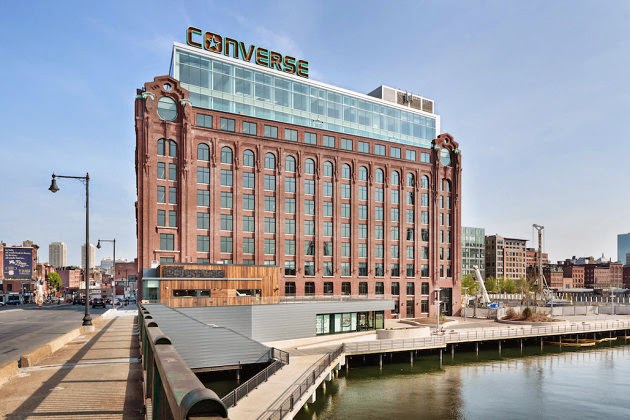
 but en route they got a bit lost, and in 2001 they filed for bankruptcy.  But they were rescued by Nike, who bought them for $300M (considering the $1B sales last year, a pretty good ROI!) and they let Converse do what they do best, which recently culminated in the opening of a phat new headquarters this year on Boston Harbor:
that's what lots of Chucks will do for you
Recently a Merrell exec I know went up to the Tetons for a trip to see what the tourist hikers there were wearing:  Keen?  Salomon?  Merrell?  Nay.  Mostly, of course.....Chucks (and Nike Frees, which I would consider to be the 2010 version of Chucks: originally intended to be athletic shoes, but made the transformation  - via, essentially, artistic renditions on the originals - into pop culture shoes).   

Ironically, I think the reason that people like Chucks so much is exactly what they are not: fancy, expensive, over-built, over-hyped, over-promised, oft-changed shoes that the athletic/outdoor companies continuously feed us, because that's their business model, vs having the WD-40 of footwear.    And ironically, Chucks are surprisingly durable:  the sole is "vulcanized", which means that the rubber sidewalls are put on in strips and the sole is attached with heat in an autoclave, so there's not the gluing of the rubber outsole to the a typical athletic shoe's EVA "midsole" and then to the textile uppers, so you never get sole delaminations and the upper stays attached. 

And the truth is that while sure we'd all love to think of ourselves as getting out and getting after it in our activities and sports all the time, the truth is that most of the time we are just hanging out or going out, neither of which is really all that demanding on footwear, and a comfy, cheap, canvas, zero-drop 1 pound shoe works just fine.  

So sure, when I am running I'm in running shoes, and when I ride I'm in cycling shoes (though Chucks are clearly the shoes of choice for my cruiser):
and in the winter I'm not in them so much, but for pretty much everything else, my considerable shoe pile can really be boiled down to one thing: