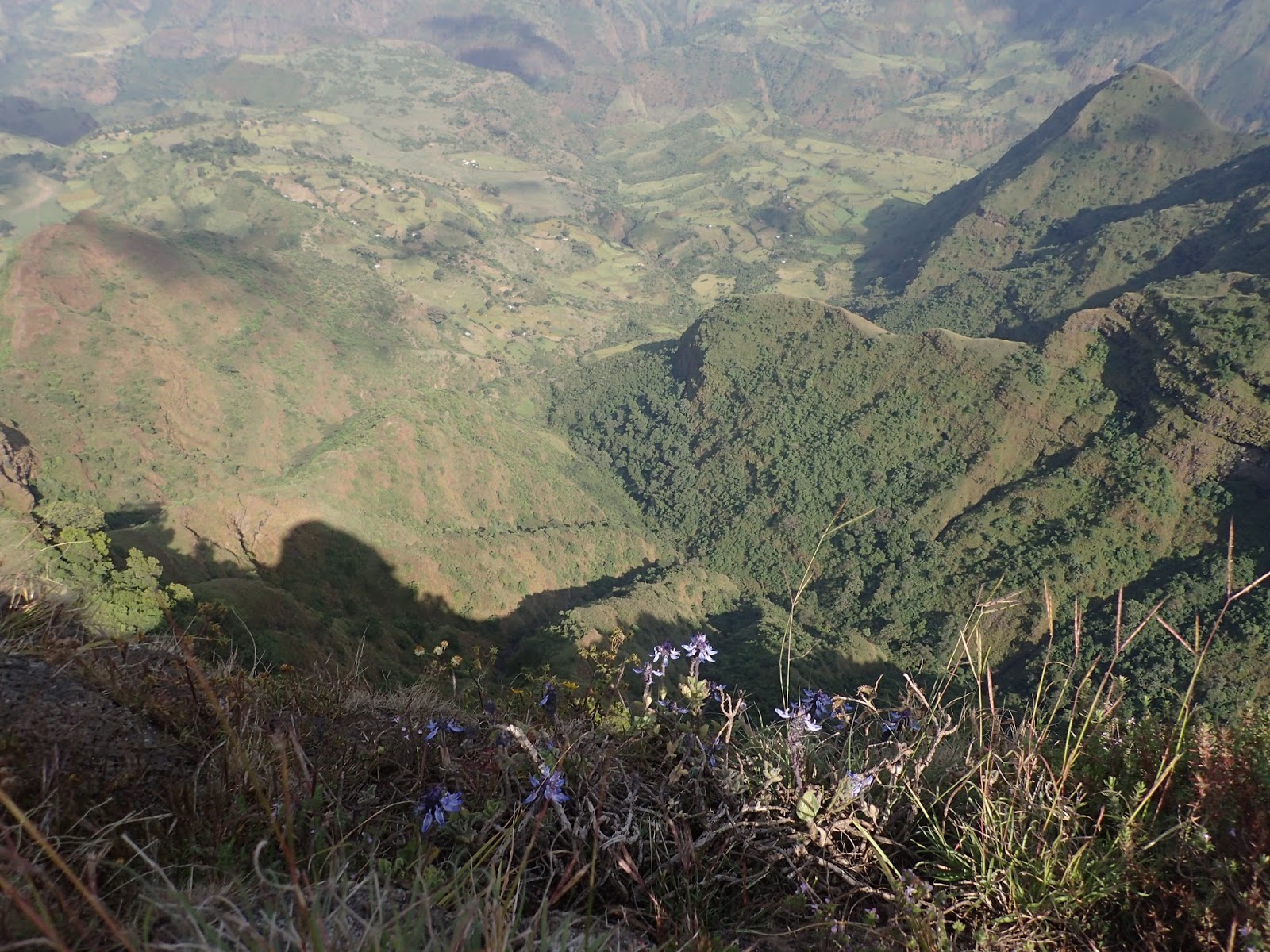
To pick up where I left off on our little sojourn around northern Ethiopia -since it's been an inexplicable amount of time since did the last post (not sure what I've been doing; I haven't been skiing much!) we rode through the highlands of Tigray and did a long climb up into the Simien Mountains, which is one of the big ranges of Africa and also is home to a few quite rare animals, including
Walia ibex, the
African Wolf, (which they just recently discovered is actually more wolf than jackal, and is endangered) and a ton of big birds including the super cool
lammergeier. Visiting the Simien mountains was the main reason that we completely changed our original itinerary.
At last check I had bonked pretty hard, was saved by some locals who kindly delivered a coupla cokes, and then stumbled into the fancy lodge that was our destination swooning with yet another bonk:
 |
| I was wiped. |
But a great meal and a great night of sleep in the beautiful
Limalimo Lodge brought me back to life for good.
I suppose every tourist area in every developing country has "eco lodges" like this that are sort of ridiculously nice by any standard, much less developing-country standards, but Limalimo was pretty exceptional on a couple of different levels. It was envisioned by a couple of Simien mountain guides who wanted to make a pretty awesome place, and somehow they pulled off financing and building a pretty incredible
rammed-earth lodge perched on top of a cliff in an area that consists of mostly of homes made of bamboo and mud. They help their financial situation by charging a fair bit for their place, but they get the clientele who will pay for it and we were lucky that they had space for us.
 |
| A German guy arrived at the lodge in this; the kids playing soccer around it live in mud huts. Weird. |
Simien park rules specify that you not only are mandated to have a guide, but also need to have an armed security guard accompany you:
 |
| resting while hiking is a good time to clean your gun. |
Ironic considering that this isn't the African alpha predator safari and the animals that you are likely to see are about as mellow as they come:
 |
| tourons hanging with baboons. these guys were so mellow; it was pretty intoxicating just to sit with them and watch them play and interact with each other. |
We had planned a big day of hiking and emphasized to our guides that we were planning on more than little strolls, but early on in the day it became Ash's turn to be ailing. She and I assumed she was getting a little car sick on the bumpy, windy road into the mountains, but even moving up to the front of the van didn't help. The guides assumed that she was getting altitude sickness the way a lot of tourists do there, but we knew that 10,000 feet was really common for us in the Wasatch and that wasn't it. Ash was determined to hike and gamely kept on trying:
 |
| a 1500 foot waterfall |
 |
| trying to get rid of the dizzies |
but ultimately ended up being down hard for about a full day, fortunately in the relative lap of luxury of the very-sleepable Limalimo. A lot of sleep and a couple of Cipros and she bounced back strong:
 |
| "ok, I'm ready to go!" |
 |
| back on bike |
A few scenic shots from the lodge:
 |
| the only rain we saw on the trip made a nice 'bow |
 |
| from the sunset the other direction |
 |
| only a few hundred yards from the lodge. big views! |
 |
| that farmland in the background has no access roads for tens of miles. |
 |
| is that sac full of poison? |
A day's ride brought us to Gondar, which is a bustling city with huge castle in the middle of town that looks more reminiscent of Windsor than Africa:
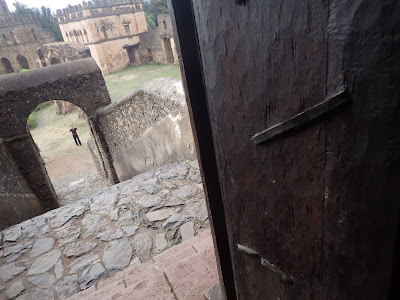 |
| a cool door with a huge staple. |
 |
| coupla dork tourists |
 |
| but it was nice to see that Ethiopians were dork tourists as well. |
 |
| the bigger cities had great bakeries |
Apparently the capital of Ethiopia moved from city to city as various leaders and areas rose/fell in power, which extended through modern times, since the current capital city Addis Ababa was only founded around 1890 (and now has ~6 million people).
We met a great guy who was determined to show us the best way to ride out of town but couldn't leave his hotel/restaurant, so we came up with the idea of following a tuk-tuk. He gave the guy the directions, and we waded into the sea of tuk-tuks trying to keep ours - which looked exactly like all the others - close with furious pedaling and bold bike handling in the thick of it:
and finally ended up back out on the quiet country roads:
 |
| "Hey, can you put that gun to some use and watch my bike for a few minutes?" |
 |
| We didn't see any trucks that said "Trump" on them..... |
 |
| guns are a part of rural life in Ethiopia. |
 |
| Once again, rock reminiscent of Utah |
In Addis I had met a 60-ish German woman who was doing a 2 year tour of Africa, and of course two weeks later we bumped into her on the road.
An interesting mix; she had no problems traveling by herself in Africa, but her attitude and route choices were odd; she had no interest in seeing any of the cool stuff we had seen, and was determined to get into hot, flat, windy, and desolate eastern Sudan (after a 2 week wait in Addis for her visa) and - like a lot of tourers we meet - was carrying way too much stuff. So it goes.
 |
| As in all developing countries, people take full advantage of moving vehicles to transport as much as possible, even if it's just a lot of empty bottles. |
 |
| building a house. What would OSHA think about this? |
We rattled onward, staying at a couple of "hotels" that were about as bleak as the Limalimo was palatial, but the food was consistently good:
 |
| A western/African blend of injera with scrambled eggs...just for us! |
and had another all-day climb back up into the mountains.
 |
| These eucalyptus trees were thriving at over 10,000 feet. |
The guy we had connected with for our route had told us that in the far north the kids knew not to throw rocks at bicyclists, but we had ventured into a zone where few cyclists went, and - particularly with the slow climbing - we had a few instances. I actually got hit once, and in a rage I surprised the kids by veering of the road and chasing them on my bike through a field (which they thought was hilarious) and when I caught back up with Ash she told me about her interaction with one kid: he was running alongside her grabbing at her rack so she veered into him, he turned to dash into the adjacent field but didn't take into account that Ethiopians tend to build (very effective) "fences" out of super-thorny acacia tree branches, and the kid did a full-on belly flop onto a pile of acacia (which he thought was as hilarious as we did).
We needed to leave the buffed paved roads to get to the end of tour; even though Lalibela is the most famous tourist destination in Ethiopia it's only serviced by gravel roads that are based on big embedded rocks (most folks fly there). We had a 2+ thousand foot descent, but after only a mile or so we started to think about hitching a ride:
 |
| hard to see the embedded rocks, but Ash is on the wrong side trying to avoid them. |
And we got one:
It was sort of crushing to lose all the elevation that we had gained and miss out on a descent, but the potential for flatting and getting bounced around hard by the embedded rocks loomed large.
We surprised the driver by saying we wanted to get out as soon as the road started going back uphill, and then soon enough we saw that they had paved one lane:
 |
| they littered the lane with rocks to keep cars off the pavement while it cured, but it looked to us like the "new" pavement was months old! |
The Italians built the original gravel roads, and the Chinese are now paving them. Here's a boss man:
Lalibela is famous for its churches. Around the 12th century King Lalibela - the king of the Ethiopia region at that time - decided to throw down hard and take the ambitious church building techniques of
Petra (in Jordan) and build upon (so to speak) what the carved-into-hillsides churches that we visited further north in Tigray had started and just dig straight down into hillsides and carve churches out of solid basalt.
The concept of excavating holes while leaving enough rock to build a multi-story church seems sort of mind boggling using today's available technology, much less using tools of the 12th century, and according to local lore it took "only" 20 years to build a dozen churches.
 |
| This is a World Heritage site, and they invested a lot of money in big steel girders holding up huge ceilings to keep the elements off the churches. The fact that they lasted hundreds of years without those pretty unsightly beams made me wonder a bit about their appropriateness (and most of the churches didn't have these roofs). |
 |
| Ash giving the inside of one of the churches perspective. All those columns were once just connected rock. |
 |
| And these images were carved into those columns. |
 |
| Plenty of tourists throwing down $50/day to see these churches. |
 |
| there are many of the gratuituous religious paintings too, that have remarkable clarity considering they are 800+ years old. |
 |
| Priests hung out inside and were fine with being photographed, when they weren't surfing their phones.... |
They dug slot canyons to move the rock out of the "holes"
 |
| Ash doing her SI swimsuit pose in one of the church slots |
 |
| Best door ever. that's one piece of wood! |
 |
| another great door. Ash wishing we could have one like that for our house! |
 |
| I'd love to have met the guy who modeled this bearded wonder.... |
 |
| and interesting use of a modified swastika. Ironically, this image has been used globally by very peaceful religions - including Christianity. |
We had heard that getting a local guide was invaluable, and we took that advice and were introduced to Getay, who indeed proved to be not only a wealth of information about Lalibela as we expected, but he was also very willing to talk about life, politics, and warfare in Ethiopia, which was rare.
Getay was a soldier in two different wars (against the communist Derge and the Eritreans), loves Lalibela, and is taking steps to start a new solar panel business, which has a lot of potential in the high desert.
He also helped us navigate the local market:
 |
| Almost a little overwhelmed |
 |
| Salt is super valuable; back in the day it was literally more expensive than gold in that region |
We also had the opportunity to visit a church nearby that was having a celebration, and we joined thousands of people huddling around a small church.
 |
| trying hard to be discreet |
 |
| at least she's got her holey socks on! |
some various characters from the celebration
 |
| other tourists came trooping in. |
Getay introduced us to a friend, who fed us lunch and insisted we drink some of her local brew
We also drove a couple of hours north to yet another carved out church (it's what you do in that area).
it's got a buttered door (for maintaining longevity, apparently)
One somewhat unnerving thing is that there are apparently thousands of bodies stashed behind the church, and the dry air in the cavern has preserved them well:
 |
| a bit creepy, but fascinating. |
this guy is unfazed by spending his working life near thousands of mummies
Being the aerobic geeks we are, we asked Getay what we could do in the morning before our noon flight, and he was kind enough to indulge us on a dawn patrol hike to a ridge a few thousand feet above town:
It also occurred to me that I needed at least one pic of the least-appreciated, but invaluable members of the Ethiopian community:
There are more burros in Ethiopia than any country in the world (6 million!), and the Ethiopian people use - and unfortunately abuse - them extensively. There's actually an org that works to protect them and educate locals the value of treating them well: the
Donkey Sanctuary. We really developed a love and respect for these noble and tough little guys.
And their brethren small horses get a good workout hauling touristos around:
And finally it was time to go home. There aren't any bike boxes in Ethiopia (most folks ride their bikes for years with bubble wrap on the tubes) so we just winged it by covering up the drivetrain with cardboard and our first inter-country flight went fine:
But they decided to shrink wrap the bikes for the international flight:
 |
| these guys took this project very seriously, and to their credit, it worked! |
All in all one of the best bike tours ever. Ethiopia has great food, super nice people, incredible riding with very little traffic, beautiful, and with a fascinating history and current society. I'm super psyched that Ash was able to get away from a really busy fall with Wasatch Community Gardens to make it happen.